The Science of Memory: How to Learn Faster and Retain More
Have you ever spent hours studying for an exam, only to forget everything a few days later? If so, you’re not alone. Many students believe that learning is simply about reading the same material repeatedly or spending more hours with their books. In reality, the human brain doesn’t work that way. Memory isn’t about how long you study—it’s about how you study. Understanding the science behind memory can transform the way you learn, helping you remember information for weeks, months, or even years.
The good news is that you don’t need a “photographic memory” to become an effective learner. By using a few research-backed strategies, you can learn faster and retain more.
Understand how memory works
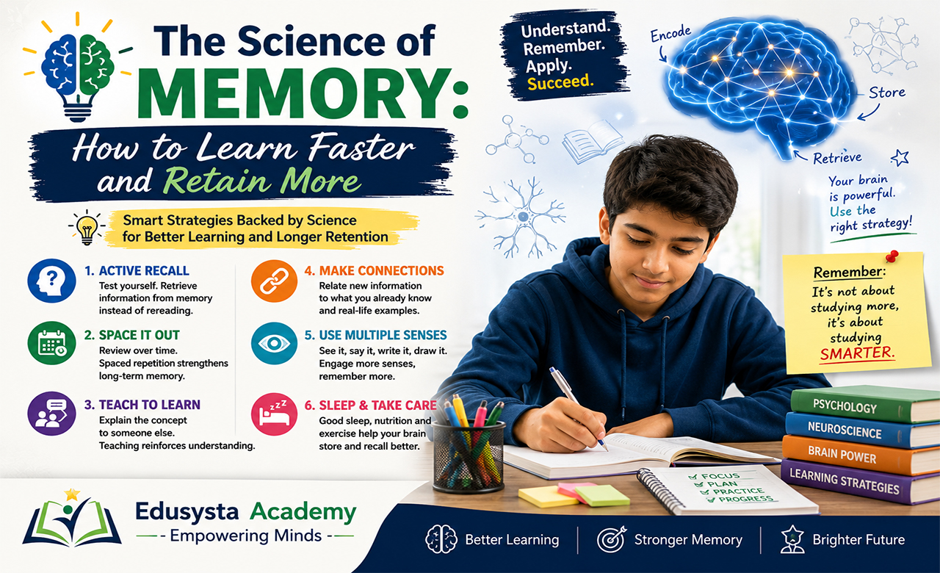
Memory is formed in three stages: encoding, storage, and retrieval. First, your brain receives information (encoding). Then it stores that information, and finally, it retrieves it when needed. The more actively you engage with information during the encoding stage, the easier it becomes to recall later.
Replace passive reading with active recall
One of the biggest mistakes students make is rereading their notes repeatedly. Instead, close your book and try to explain the topic from memory. Ask yourself questions or use flashcards. This process, known as active recall, strengthens neural connections and improves long-term retention.
For example, after studying photosynthesis, don’t reread the chapter immediately. Instead, try drawing the process or explaining it to a friend without looking at your notes.
Space out your learning
Cramming the night before an exam may help you remember facts temporarily, but they disappear quickly. A better approach is spaced repetition—reviewing information over several days or weeks. Each review strengthens your memory and reduces forgetting.
Even reviewing a topic for just ten minutes every few days is often more effective than studying it for three hours in one sitting.
Teach someone else
A simple way to test your understanding is to teach the concept to another person. If you can explain a difficult topic using simple language, it means you truly understand it. If you struggle, you’ve identified the areas that need more attention.
This technique works equally well if you imagine teaching an invisible classroom or even explain concepts aloud to yourself.
Connect new ideas to what you already know
Your brain stores information more effectively when it builds connections. Instead of memorizing isolated facts, relate new ideas to your previous knowledge or real-life experiences.
For instance, learning about supply and demand becomes easier when you think about why the prices of concert tickets or smartphones increase during periods of high demand.
Use multiple senses
The more senses involved in learning, the stronger the memory. Read your notes, draw diagrams, watch educational videos, create mind maps, or discuss ideas with classmates. Combining visual, verbal, and practical learning makes information easier to remember.
Prioritize sleep and healthy habits
Memory consolidation happens while you sleep. A tired brain struggles to process and store information effectively. Aim for consistent sleep, stay hydrated, exercise regularly, and eat nutritious foods. Your brain performs best when your body is healthy.
Remember, studying until 2 a.m. is often less effective than getting a good night’s sleep before an exam.
Eliminate distractions
Every notification, message, or social media update interrupts your concentration. Deep learning requires focused attention. Study in short, distraction-free sessions and keep your phone away whenever possible. Even 25 minutes of focused learning can be remarkably productive.
The science of memory reminds us that successful learning is not about working harder—it is about working smarter. Small changes in your study habits can produce remarkable improvements in understanding and retention. Active recall, spaced repetition, meaningful connections, and healthy routines allow your brain to perform at its full potential.
Knowledge is not measured by how much information you can temporarily memorize but by how much you can understand, apply, and remember when it truly matters. Every study session is an opportunity to strengthen your mind, build confidence, and move one step closer to your goals. Learn with purpose, practice consistently, and trust the incredible ability of your brain to grow. After all, the strongest memory is not the one that stores the most facts—it is the one that helps you create a lifetime of meaningful learning.